taia.ds
Datastar + XState-style state machines + Clojure: an opinionated, component-based library for server-side UI.
io.github.danbunea/taia.ds {:mvn/version "0.3.1"}
Server-side UI components over Datastar SSE, LiveView-style, for Clojure/Ring.
A component is a pure render function (fn [ctx] -> hiccup) plus an XState-style hierarchical state machine; the
browser round-trips the component's signals (:memory, :state) as JSON, the server runs the
transition and streams back patches. Long-lived components keep an SSE connection open so the server
can push UI with send-ui!, or send the component events with send-event!.
Extracted from a production Clojure application, where it drives the whole product UI.
A component is a core.async.flow of two procs between an in-chan and an out-chan: the
controller runs the component's state machine, the view is its render fn. A click puts the
event, and the component's signals, on the in-chan; the render leaves on the out-chan and Datastar
morphs it into the page. A connected component's flow stays up as long as its SSE stream, so the
server can send it events too (send-event!):

A connected component's flow has two ways in, through the same in-chan. On the live counter, a
click POSTs +1 with the tab's signals and gets the render back; from the REPL,
(ds/send-event! "live1" "demo-user" "increment" {:count 2}) sends the same event with the memory
as params, the same controller code runs, and the new value goes down the page's open SSE stream,
with no click and no request:

(Both are generated: scripts/component_flow_svg.clj writes the
animated SVGs in docs/img/, and bb component-flow-gif renders the GIFs. The click in
more detail, signal store and morph included, is in example 1.)
What you write
Two namespaces per component: a controller (the state machine) and a view (the render fn). Here is the whole counter, lightly trimmed (the example's files add test ids, docstrings and a state viewer):
(ns my.app.components.basics.counter-controller)

(defn seed      [ctx _] (update-in ctx [:memory :count] #(or % 0)))
(defn increment [ctx _] (update-in ctx [:memory :count] inc))
(defn decrement [ctx _] (update-in ctx [:memory :count] dec))
(defn reset     [ctx _] (assoc-in ctx [:memory :count] 0))

(def machine
  {:id      :counter
   :initial :displayed
   :states  {:displayed {:on {:INIT      {:actions seed}
                              :INCREMENT {:actions increment}
                              :DECREMENT {:actions decrement}
                              :RESET     {:actions reset}}}}})
(ns my.app.components.basics.counter
  (:require [taia.ds.datastar.interface :as ds]))

(defn- post [cid event]
  (str "@post('/ds/nds/basics.counter/" cid "/" event "')"))

(defn counter [{:keys [component-id memory] :as ctx}]
  [:div.card {:id component-id :data-signals (ds/ctx->data-signals ctx)}
   [:h2 "Counter"]
   [:p.big (str (:count memory 0))]
   [:div.row
    [:button {"data-on:click" (post component-id "decrement")} "−"]
    [:button {"data-on:click" (post component-id "increment")} "+"]
    [:button {"data-on:click" (post component-id "reset")} "Reset"]]])
Plain functions and data: no handlers, no channels, no SSE, no registration. taia.ds does the rest:
- Routing.
POST /ds/nds/basics.counter/counter1/incrementreaches your machine as[:INCREMENT params]. You mount three handlers once for the whole app, not per component. - Discovery. It finds
counterandcounter-controllerfrom the namespace name. - Signals.
:memoryand:stateround-trip throughdata-signalsand come back as the ctx of the next event. A key your action removes is deleted in the browser too. - The flow. Your controller and view run as the two procs of a
core.async.flow, built per event. For a connected component it lives as long as its SSE stream. Nothing is kept between events: each starts from the tab's signals, or from a server event's params. - Connected components. Streams per user, heartbeats, reconnects, and
send-event!/send-ui!for pushes from the server. - The response. Hiccup becomes HTML and Datastar morphs it in by id; an effects list goes out as SSE.
- Observability. Traces through mulog, plus an observer hook for your metrics.
If you know re-frame
The shape is the same, the place is different. A re-frame app dispatches events, event handlers
turn db + event into a new db, subscriptions feed views that render hiccup, and all of it runs
in the browser. Here the browser only has Datastar: it POSTs the event together with the
component's signals, the server does the rest and sends HTML back.
| re-frame (browser) | taia.ds (server) |
|---|---|
app-db | the component's signals (:memory, :state), round-tripped as JSON |
dispatch [:increment] | data-on:click="@post('.../counter1/increment')" |
dispatch [:add-todo {:title "x"}] | the payload rides the request, as the query string @post('.../add-todo?title=x') or the POST body (the signals); the action receives [:ADD_TODO {:title "x"}] |
reg-event-db handler | an action in the component's state machine, (fn [ctx event] -> ctx) |
reg-event-fx effects | :invoke for async work; effects list (:patch, :patch-signals, :execute-script) |
| subscription + Reagent view | the pure render fn (fn [ctx] -> hiccup) |
| React re-render | Datastar morphs the returned HTML by element id |
What you give up: no client-side state besides the signals, one round trip per event. What you
get: no ClojureScript build, no client/server state sync, server data at hand in every handler,
and send-ui! to push UI to connected clients.
If you know XState
The state machine is an XState-style statechart written as a
Clojure map: nested :states, :initial, :on transitions with :cond guards and :actions,
and :invoke with :on-done / :on-error. The differences: an action is a pure
(fn [ctx event] -> ctx) (XState's assign, nothing else), an invoke runs synchronously inside
the same request, and there are no parallel states, history states or delayed events. Each HTTP
request is one transition call: the browser sends the current state and memory, the server
sends back the new ones with the HTML.
This is the wizard example's machine (wizard_controller.clj). Left out of the picture: a NEXT whose guard fails stays put and sets :error, and a machine-wide RESET returns to details.
stateDiagram-v2
  direction LR
  [*] --> editing
  state editing {
    direction LR
    [*] --> details
    details --> address : NEXT [name ok]
    address --> review : NEXT [address ok]
    address --> details : BACK
    review --> address : BACK
  }
  review --> saving : SUBMIT
  saving --> done : save! ok / keep receipt
  saving --> review : save! failed / keep error
The table in docs/state-machines.md maps each XState key to its Clojure counterpart.
What is in the jar
| Brick | Namespace | Role |
|---|---|---|
datastar | taia.ds.datastar.* | Ring handlers, request pipeline, component discovery, SSE push, observer hook, datastar.js + sse-reconnect.js resources |
state-machines | taia.ds.state-machines.* | Hierarchical state machine (transition), malli schemas, mock helpers |
logging | taia.ds.logging.* | Thin mulog wrapper (trace, with-context, trace-when); no publisher is started |
extensions | taia.ds.extensions.* | assoc-if and friends |
Runtime dependency note: hyperfiddle/rcf and tortue/spy are real (small) runtime dependencies —
the test blocks live inline in the sources and the state machine requires spy.core. RCF blocks
are no-ops unless you call (hyperfiddle.rcf/enable!).
Documentation
- Getting started · Components · State machines · Connected components and push
- Testing components · Gotchas (read this one) · Migration · API index
- Examples: seven components in
bases/examples, one concept each, each with a walkthrough and an executable spec.bb devserves them and prints the URL (the page is itself a component).
The same articles render on cljdoc once the jar is on Clojars (doc/cljdoc.edn).
Projects using taia.ds
-
TodoMVC-AI-Agent: the classic TodoMVC with an AI agent that manages the same list through conversation. The page is a
taia.dscomponent with its state machine; the request pipeline, SSE push anddatastar.jscome from the library.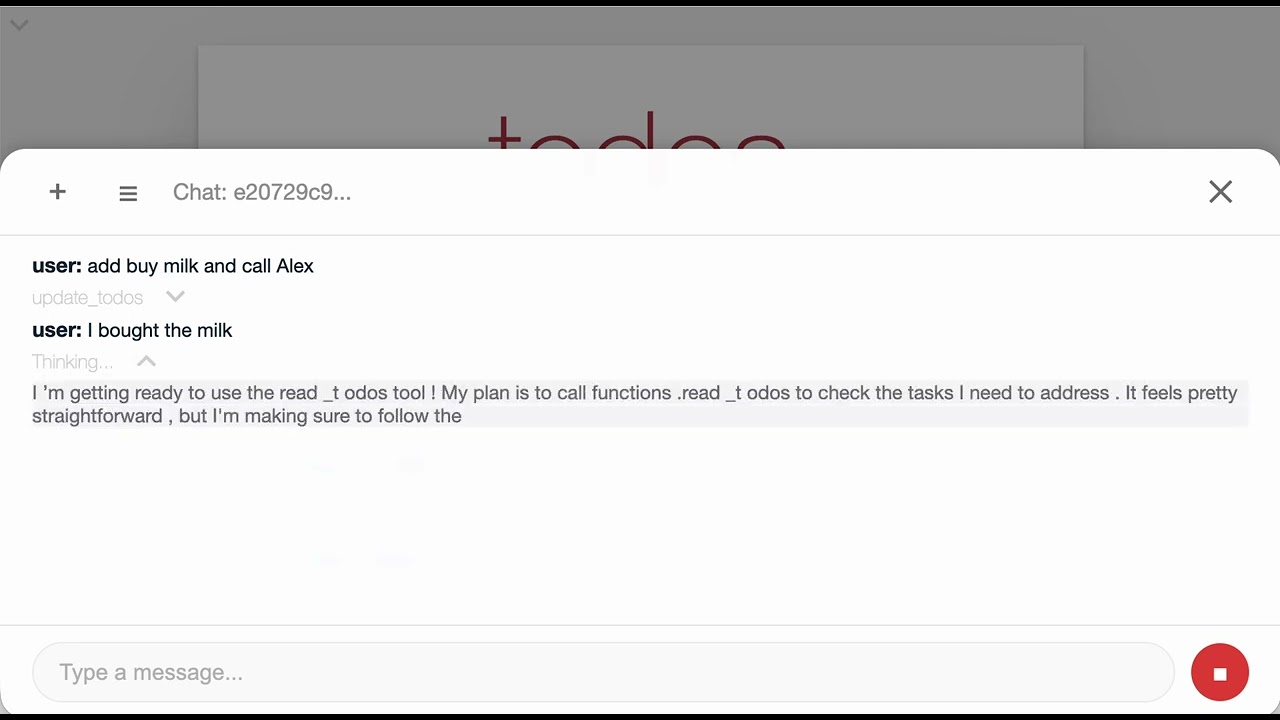
Wiring it into an application
The library ships no routes: your base owns them. Mount the three handlers on these three shapes
(reitit shown; any router that sets :path-params works):
(require '[taia.ds.datastar.interface :as ds])

["/ds"
 ["/nds"
  ["/:component/:component-id/:controller/:event" {:handler ds/handler-component-event}]
  ["/:component/:component-id/:event"             {:handler ds/handler-component-event}]]
 ["/nds-connect"
  ["/:component/:component-id/:event"             {:get  {:handler ds/handler-connected-component-connect}
                                                   :post {:handler ds/handler-connected-component-event}}]]]
The handlers expect, on the request:
| Key | Who sets it | Used for |
|---|---|---|
:path-params :component :component-id :event (:controller optional) | router | which component / FSM event |
:body-params (JSON, e.g. via muuntaja) or [:params :datastar] (GET) | your middleware | the signal store round-trip |
[:params :logged-user :user/id] | your auth middleware | keys SSE connections per user |
:app-config (optional) | your middleware | forwarded into the component ctx |
handler-connected-component-connect is async-only ([req respond raise]): run Jetty with
:async? true (or an equivalent async adapter).
At startup:
(ds/set-component-search-paths! ["my.app.components"])   ; required: the default is empty
(future (ds/warm-component-cache! ["home.home" "chat.chat"]))   ; optional, avoids first-request load cost
(ds/set-observer! my-metrics-fn)                                 ; optional, see docstring
Static assets — add (ring.middleware.resource/wrap-resource handler "datastar") (plus
wrap-content-type, browsers refuse a module script without a MIME type) and load them from your
page head:
[:script {:type "module" :src "/js/datastar.js"}]     ; Datastar v1.0.0-RC.8
[:script {:src "/js/sse-reconnect.js" :defer true}]   ; reconnect watchdog for /ds/nds-connect streams
Server-initiated pushes to an open connected component:
(ds/send-ui! component-id user-id [[:patch [:div#cc1 "hello"]]])
Full-page renders at a canonical URL (GET / → a page component's INIT):
(let [{:keys [html]} (ds/process-component-event req "home.home" "home" "INIT" nil)] ...)
Writing a component
Under one of the search-path prefixes, <dir>.<name> is resolved from "<dir>.<name>":
my/app/components/counter/counter.clj             ; (ns my.app.components.counter.counter)
my/app/components/counter/counter_controller.clj  ; (ns my.app.components.counter.counter-controller)
counter.cljdefines(defn counter [ctx] ...)— the render fn is named after the last namespace segment and returns hiccup. Useds/ctx->data-signalsfor thedata-signalsattribute.counter_controller.cljdefinesmachine, a hierarchical state machine map (:id,:initial,:states,:on); actions are(fn [ctx params] -> ctx).- Events arrive as
POST /ds/nds/counter.counter/<id>/<EVENT>;:memoryis your persistent state,:statethe FSM state keyword.
The examples go from a counter to TodoMVC.
Effect vocabulary a render fn may return instead of plain hiccup: [[:patch hiccup opts] …],
[:patch-signals map opts], [:execute-script js opts]; opts keys/values may be :d*/… keywords
(resolved against starfederation.datastar.clojure.api). send-ui! additionally accepts
[:broadcast hiccup opts] to reach every user connected under a component-id.
Development
This is a Polylith workspace.
bb test          # Kaocha + RCF inline tests (clojure -M:dev:test)
bb e2e-test      # Playwright against the examples app (needs Node >= 18); bb e2e-test <spec> [--headed]
bb check         # poly check
bb info          # poly info
bb dev           # examples app on port 7788, prints the examples URL (nREPL on 7789)
bb api-index     # regenerate docs/api.md from the interface namespaces
bb format        # cljfmt
bb jar           # target/taia.ds-<version>.jar  (version = 0.1.<git commit count>, or :version "x.y.z")
bb install       # into ~/.m2
bb deploy        # to Clojars
clojure -M:poly <cmd> runs any other poly command. The library artifact is projects/taia-ds
(the four bricks, nothing else); projects/examples adds the examples base and is never
published. build.clj inlines the bricks into one jar whose pom lists Maven libraries only.
Publishing
- Verify the
io.github.danbuneagroup once on Clojars: create a public GitHub repository namedclojars-danbunea(see Verified Group Names). - Create a Clojars deploy token and export
CLOJARS_USERNAMEandCLOJARS_PASSWORD(the token). bb deploy(optionallybb deploy :version '"0.3.1"'), then tagv<version>.
Migrating from the in-app namespaces
| Before (in-app) | After |
|---|---|
ds.interface, ds.adapters.*, ds.domain.* | taia.ds.datastar.interface, taia.ds.datastar.adapters.*, taia.ds.datastar.domain.* |
state-machines.* | taia.ds.state-machines.* |
logging.interface | taia.ds.logging.interface |
extensions.interface | taia.ds.extensions.interface |
search path "ds.adapters.components" | gone: the library has no components of its own, so the default is [] and the application lists only its own prefixes |
License
Eclipse Public License 2.0.
Can you improve this documentation?Edit on GitHub
cljdoc builds & hosts documentation for Clojure/Script libraries
| Ctrl+k | Jump to recent docs |
| ← | Move to previous article |
| → | Move to next article |
| Ctrl+/ | Jump to the search field |