shuriken
Small yet effective Clojure weapons.
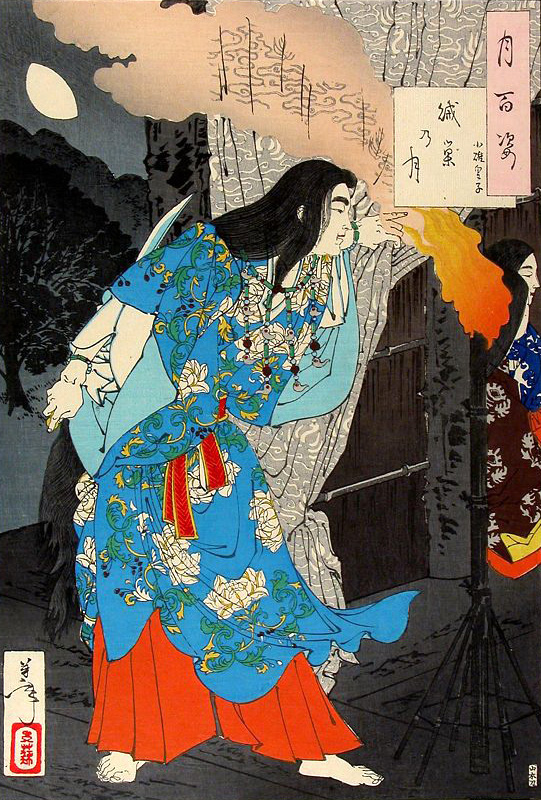
Yamato Takeru dressed as a maidservant, preparing to kill the Kumaso leaders.
Usage
[net.clojars.unexpectedness/shuriken "0.14.53"]
(ns my-ns
  (:require [shuriken.core :refer :all]))
API doc
Grown-ups
Libraries that were originally part of shuriken.
- lexikon: Reify, manipulate and replay the lexical environment in Clojure.
- arity: Get and fake arities of Clojure functions.
- threading: A Clojure threading macros library as sobber as its name.
- weaving: Weaving is to lambdas what threading is to s-expressions.
- methodman: Shaolin moves for Clojure methods.
- dance: Advanced tree walking in Clojure.
Associative structures
The boring
map-keys&map-vals.filter-keys&filter-vals.remove-keys&remove-vals.submap?.
flatten-keys
(flatten-keys {:a {:b {:c :x
                       :d :y}}})
;; {[:a :b :c] :x
;;  [:a :b :d] :y}
deflatten-keys
(deflatten-keys {[:a :b :c] :x
                 [:a :b :d] :y})
;; {:a {:b {:c :x
;;          :d :y}}}
deep-merge
(deep-merge {:x {:a :a  :b :b  :c :c}}
            {:x {:a :aa :b :bb}}
            {:x {:a :aaa}})

;; {:x {:a :aaa  :b :bb  :c :c}}
index-by
(def ms [{:a 1 :b 2} {:a 3 :b 4} {:a 5 :b 4}])

(index-by :a ms)
;; {1 {:a 1 :b 2}
;;  3 {:a 3 :b 4}
;;  5 {:a 5 :b 4}}

(index-by :b ms)
;; clojure.lang.ExceptionInfo (Duplicate entries for key 4)

(index-by :b (fn [key entries]
               (last entries))
          ms)
;; {2 {:a 1 :b 2}
;;  4 {:a 5 :b 4}}
split-map
(let [m {:a 1 :b 2 :c 3 :d 4}]
  (split-map m [:a :b])       ;; [{:a 1 :b 2} {:c 3 :d 4}]
  (split-map m [:a :b] [:c])) ;; [{:a 1 :b 2} {:c 3} {:d 4}]
map-difference
(let [m {:a 1 :b 2 :c 3}]
  (map-difference m {:a :x})          ;; {:b 2 :c 3}
  (map-difference m {:a :x} {:b :x})) ;; {:c 3}
map-intersection
(let [m {:a 1 :b 2 :c 3}]
  (map-intersection m {:a :x})         ;; {:a 1}
  (map-intersection m {:a :x :b :x})   ;; {:a 1 :b 2}
  (map-intersection m {:a :x} {:b :x}) ;; {}
  (map-intersection m {})              ;; {}
  (map-intersection m nil))            ;; {}
getsoc
Works like get if the key is present in the hash, else works like assoc.
Returns a vector of the form [get-or-stored-value new-coll].
(getsoc {:a 1} :a (constantly 2)) ;; => [1 {:a 1}]
(getsoc {} :a (constantly 2)))    ;; => [2 {:a 2}]
Exceptions
silence
(silence ArithmeticException (/ 1 0))
;; => nil

(silence [ArithmeticException]
  (do (println "watch out !")
      (/ 1 0)))
;; watch out !
;; => nil

(silence "Divide by zero" (/ 1 0))
;; => nil

(silence #"zero" (/ 1 0))
;; => nil

(silence :substitute
         (fn [x]
           (isa? (class x) ArithmeticException))
         (/ 1 0))
;; => :substitute
thrown?
(thrown? ArithmeticException (/ 1 0))
;; => true

(thrown? "Divide by zero" (/ 1 0))
;; => true

(thrown? #"zero" (/ 1 0))
;; => true

(thrown? #{ArithmeticException} (/ 1 1))
;; => false

(thrown? (fn [x]
           (isa? (class x) ArithmeticException))
         (throw (IllegalArgumentException. "my-error")))
;; raises:
;;   IllegalArgumentException my-error

(thrown? {:type :oops}
         (throw (ex-info "Oops" {:type :oops :value :abc})))
;; => true
Sequential structures
get-nth, get-nth-in, assoc-nth, assoc-nth-in, update-nth & update-nth-in
Respectively like get, get-in, assoc etc... but also work on lists.
insert-at
Insert an item into a list or a vector.
(insert-at [1 2 3]  0 :x) ;; => [:x 1 2 3]
(insert-at '(1 2 3) 1 :x) ;; => '(1 :x 2 3)
(insert-at '(1 2 3) 3 :x) ;; => '(1 2 3 :x)
(insert-at [1 2 3]  4 :x) ;; => java.lang.IndexOutOfBoundsException
(insert-at [1 2 3] -1 :x) ;; => java.lang.IndexOutOfBoundsException
slice
(let [coll [1 1 0 1 0 0 1 1]]
  ;; the default
  (slice zero? coll) ;; by default, :include-delimiter false, include-empty true
  ;; ((1 1) (1) (1 1))

  (slice zero? coll :include-empty true)
  ;; ((1 1) (1) () (1 1))

  (slice zero? coll :include-delimiter :left)
  ;; ((1 1) (0 1) (0 1 1))

  (slice zero? coll :include-delimiter :right)
  ;; ((1 1 0) (1 0) (1 1))

  (slice zero? coll :include-delimiter :right :include-empty true)
  ;; ((1 1 0) (1 0) (0) (1 1))
  )
separate
Returns a vector of [(filter pred coll) (remove pred coll)].
(let [coll [1 1 0 1 0 0 1 1 0]]
  (separate zero? coll)
  ;; [(1 1 1 1 1) (0 0 0 0)]
  )
order
Order a sequence with constraints.
(order [1 2 3] {2 1           3 :all})
(order [1 2 3] [[2 1]         [3 :all]])
(order [1 2 3] [[2 :before 1] [:all :after 3]])
(order [1 2 3] [[2 :> 1]      [:all :< 3]])
;; (3 2 1)
takes
Split a sequence in subsequence of predetermined length.
(takes [1 2 3] [:a :b])                ;; => ((:a) (:b))
(takes [1 2 3] [:a :b :c])             ;; => ((:a) (:b :c))
(takes [1 2 3] [:a :b :c :d :e :f])    ;; => ((:a) (:b :c) (:d :e :f))
(takes [1 2 3] [:a :b :c :d :e :f :g]) ;; => ((:a) (:b :c) (:d :e :f) (:g))
(takes [0 0 1 0 2] [:a :b :c :d :e])   ;; => (() () (:a) () (:b :c) (:d :e))
Macro
Working with forms
(is-form? 'a 1)       ; false
(is-form? 'a '[a :z]) ; false
(is-form? 'a '(a :z)) ; true

(wrap-form 'a :z)                      ; (a :z)
(->> :z (wrap-form 'a) (wrap-form 'a)) ; (a :z)

(unwrap-form 'a '(a :z))                        ; a
(->> '(a :z) (unwrap-form 'a) (unwrap-form 'a)) ; a
clean-code
Recursively unqualifies qualified code in the provided form.
(clean-code `(a (b c)))
;; (a (b c))
file-eval
Evaluate code in a temporary file via load-file in the local lexical context. Keep the temporary file aside if an error is raised, deleting it on the next run.
(let [a 1]
  (file-eval '(+ 1 a)))
Code evaluated this way will be source-mapped in stacktraces.
macroexpand-n
Iteratively call macroexpand-1 on form n times.
(defmacro d [x] x)
(defmacro c [x] `(d ~x))
(defmacro b [x] `(c ~x))
(defmacro a [x] `(b ~x))

(macroexpand-n 2 '(a 1))
; (my-ns/c 1)
macroexpand-some
Recursively macroexpand forms whose first element match a filter. Symbols are passed to filter unqualified.
(defmacro by [code]
  `(inc ~code))

(defmacro az [code]
  `(by ~code))

(macroexpand-some '#{az} '(az (+ 1 2)))
; => (user/by (+ 1 2))
macroexpand-do
(defmacro abc []
  `(println "xyz"))

(macroexpand-do (abc))

; -- Macro expansion --
; (clojure.core/println "xyz")

; -- Running macro --
; xyz
or alternatively:
(macroexpand-do MODE
  form)
Where MODE has the following meaning:
MODE | expansion |
|---|---|
nil (the default) | macroexpand |
:all | clojure.walk/macroexpand-all |
| a number n | iterate macroexpand-1 n times |
| anything else | a predicate to macroexpand-some |
Tracking exceptions in code generated by macros
To allow for better tracking of exceptions in code generated by macros,
macroexpand-do evaluates the expansion of the macro expression in a temporary
file that is kept aside for inspection and appears in the stacktrace of raised
exceptions. If no exception is raised, the file is deleted.
Meta
without-meta
(meta (without-meta (with-meta [1 2 3] {:metadata :abc}))) ;; nil
Monkey-patch
monkey-patch
(monkey-patch :perfid-incer clojure.core/+ [original & args]
  (inc (apply original args)))
Supports reload. Name and target can be vars or quoted symbols.
once
Ensures the code is executed only once with respect to the associated name. name must be a symbol, quoted or not.
(once 'only-once (println "printed once"))
(once 'only-once (println "printed once"))

;; printed once
refresh-once
(once 'a (println "a"))
;; a

(once 'a (println "a"))
;; prints nothings

(refresh-once 'a)
(once 'a (println "a"))
;; a
Namespace
fully-qualify
Returns the fully-qualified form of the symbol as if resolved from within a namespace.
(fully-qualified? 'IRecord)      ; => clojure.lang.IRecord
(fully-qualified? 'my-var)       ; => my-ns/my-var
(fully-qualified? 'alias/my-var) ; => actual.namespace/my-var
fully-qualified?
Returns true if the symbol constitutes an absolute reference.
(fully-qualified? 'clojure.lang.IRecord) ; => true
(fully-qualified? 'my-ns/my-var)         ; => true
(fully-qualified? 'alias/my-var)         ; => false
unqualify
(unqualifiy 'clojure.lang.IRecord)       ; => IRecord
(unqualifiy 'my-ns/my-var)               ; => my-var
(unqualifiy 'alias/my-var)               ; => alias/my-var
(unqualifiy 'some.path.Class/staticMeth) ; => Class/staticMeth
with-ns
Like in-ns but with the scope of a let or a binding.
(with-ns 'my-namespace ;; or (find-ns 'my-namespace)
  (def number 123))

(println my-namespace/number)
;; 123
Tree
tree-seq-breadth
(let [tree {:a {:d {:j :_}
                :e {:k :_}}
            :b {:f {:l :_}
                :g {:m :_}}
            :c {:h {:n :_}
                :i {:o :_}}}
      keys-only #(->> % (remove #{:_}) (mapcat keys))]
  (keys-only (tree-seq map? vals tree))
  ;; (:a :b :c :d :e :j :k :f :g :l :m :h :i :n :o)
  (keys-only (tree-seq-breadth map? vals tree))
  ;; '(:a :b :c :d :e :f :g :h :i :j :k :l :m :n :o)
  )
prepostwalk
A combination of clojure.walk's prewalk and postwalk. Recursively modifies form with pre-fn before descending further into the structure and then with post-fn after going up.
(defn inc-it [x]
  (if (number? x) (inc x) x))

(defn it-times-two [x]
  (if (number? x) (* 2 x) x))

(def data
  [1 2 {3 4 5 6}])

(println (prepostwalk inc-it it-times-two data))
;; [4 6 {8 10, 12 14}]
(println (prepostwalk it-times-two inc-it data))
;; [3 5 {7 9, 11 13}]
Comes equipped with prepostwalk-demo.
tree
Recursively builds a tree from root and functions
with the following signature:
(children [node]): returns the direct children ofnode.(join-branches [node children]): returns a datastructure holdingnodeand itschildren.
(defn divisors [n]
  (tree #(for [m (range 2 %)  :let [div (/ % m)]  :when (integer? div)]
           div)
        cons
        n))

(divisors 12)
;; => (12 (6 (3) (2)) (4 (2)) (3) (2))
Dev
For all features listed below:
(require 'shuriken.dev)
shuriken.monkey-patches.pprint-meta
(require 'shuriken.monkey-patches.pprint-meta)
(alter-var-root #'clojure.pprint/*print-meta* (constantly true))

(pprint ^Object ^:flag ^{:meta :yes} [1 2 3])
;; ^Object ^:flag ^{:meta :yes} [1 2 3]
shuriken.monkey-patches.syntax-quote
Before
``abc
;; (quote my-ns/abc)

(pprint ``abc)
;; 'my-ns/abc
After
(require 'shuriken.monkey-patches.syntax-quote)

``abc
;; (clojure.core/syntax-quote my-ns/abc)

(pprint ``abc)
;; `my-ns/abc

(def args [1 2 3])

(pprint (syntax-quote `(abc ~@args)))
;; `(my-ns/abc 1 2 3)

(pprint (syntax-quote `(abc ~'~@args)))
;; `(my-ns/abc ~@args)
But above all it prevents this:
(pprint ``(do (fn1 arg1 arg2) (fn2 arg3 arg4)))

(clojure.core/seq
 (clojure.core/concat
  (clojure.core/list 'do)
  (clojure.core/list
   (clojure.core/seq
    (clojure.core/concat
     (clojure.core/list 'user/fn1)
     (clojure.core/list 'user/arg1)
     (clojure.core/list 'user/arg2))))
  (clojure.core/list
   (clojure.core/seq
    (clojure.core/concat
     (clojure.core/list 'user/fn2)
     (clojure.core/list 'user/arg3)
     (clojure.core/list 'user/arg4))))))
And pprints this instead:
(pprint ``(do (fn1 arg1 arg2) (fn2 arg3 arg4)))

`(do (my-ns/fn1 my-ns/arg1 my-ns/arg2) (my-ns/fn2 my-ns/arg3 my-ns/arg4))
Can you improve this documentation?Edit on GitHub
cljdoc builds & hosts documentation for Clojure/Script libraries
| Ctrl+k | Jump to recent docs |
| ← | Move to previous article |
| → | Move to next article |
| Ctrl+/ | Jump to the search field |