taia.ds
Datastar + XState-style state machines + Clojure: an opinionated, component-based library for server-side UI.
io.github.danbunea/taia.ds {:mvn/version "0.2.0"}
Server-side UI components over Datastar SSE, LiveView-style, for Clojure/Ring.
A component is a pure render function (fn [ctx] -> hiccup) plus an XState-style hierarchical state machine; the
browser round-trips the component's signals (:memory, :state) as JSON, the server runs the
transition and streams back patches. Long-lived components keep an SSE connection open so the server
can push UI with send-ui!, or send the component events with send-event!.
Extracted from a production Clojure application, where it drives the whole product UI.
A component is a core.async.flow of two procs between an in-chan and an out-chan: the
controller runs the component's state machine, the view is its render fn. A click puts the
event, and the component's signals, on the in-chan; the render leaves on the out-chan and Datastar
morphs it into the page. A connected component's flow stays up as long as its SSE stream, so the
server can send it events too (send-event!):

A connected component's flow has two ways in, through the same in-chan. On the live counter, a
click POSTs +1 and gets the render back; the REPL's (inc!), which is
(ds/send-event! "live1" "demo-user" "increment" {}), sends the same event, the same controller
code runs, and the new value goes down the page's open SSE stream, with no click and no request:

(Both are generated: scripts/component_flow_svg.clj writes the
animated SVGs in docs/img/, and bb component-flow-gif renders the GIFs. The click in
more detail, signal store and morph included, is in example 1.)
What you write
Two namespaces per component: a controller (the state machine) and a view (the render fn). Here is the whole counter, lightly trimmed (the example's files add test ids, docstrings and a state viewer):
(ns my.app.components.basics.counter-controller)

(defn seed      [ctx _] (update-in ctx [:memory :count] #(or % 0)))
(defn increment [ctx _] (update-in ctx [:memory :count] inc))
(defn decrement [ctx _] (update-in ctx [:memory :count] dec))
(defn reset     [ctx _] (assoc-in ctx [:memory :count] 0))

(def machine
  {:id      :counter
   :initial :displayed
   :states  {:displayed {:on {:INIT      {:actions seed}
                              :INCREMENT {:actions increment}
                              :DECREMENT {:actions decrement}
                              :RESET     {:actions reset}}}}})
(ns my.app.components.basics.counter
  (:require [taia.ds.datastar.interface :as ds]))

(defn- post [cid event]
  (str "@post('/ds/nds/basics.counter/" cid "/" event "')"))

(defn counter [{:keys [component-id memory] :as ctx}]
  [:div.card {:id component-id :data-signals (ds/ctx->data-signals ctx)}
   [:h2 "Counter"]
   [:p.big (str (:count memory 0))]
   [:div.row
    [:button {"data-on:click" (post component-id "decrement")} "−"]
    [:button {"data-on:click" (post component-id "increment")} "+"]
    [:button {"data-on:click" (post component-id "reset")} "Reset"]]])
Plain functions and data: no handlers, no channels, no SSE, no registration. taia.ds does the rest:
- Routing.
POST /ds/nds/basics.counter/counter1/incrementreaches your machine as[:INCREMENT params]. You mount three handlers once for the whole app, not per component. - Discovery. It finds
counterandcounter-controllerfrom the namespace name. - Signals.
:memoryand:stateround-trip throughdata-signalsand come back as the ctx of the next event. A key your action removes is deleted in the browser too. - The flow. Your controller and view run as the two procs of a
core.async.flow, built per event. For a connected component it lives as long as its SSE stream. Nothing is kept between events: each starts from the tab's signals, or from a server event's params. - Connected components. Streams per user, heartbeats, reconnects, and
send-event!/send-ui!for pushes from the server. - The response. Hiccup becomes HTML and Datastar morphs it in by id; an effects list goes out as SSE.
- Observability. Traces through mulog, plus an observer hook for your metrics.
If you know re-frame
The shape is the same, the place is different. A re-frame app dispatches events, event handlers
turn db + event into a new db, subscriptions feed views that render hiccup, and all of it runs
in the browser. Here the browser only has Datastar: it POSTs the event together with the
component's signals, the server does the rest and sends HTML back.
| re-frame (browser) | taia.ds (server) |
|---|---|
app-db | the component's signals (:memory, :state), round-tripped as JSON |
dispatch [:increment] | data-on:click="@post('.../counter1/increment')" |
dispatch [:add-todo {:title "x"}] | the payload rides the request, as the query string @post('.../add-todo?title=x') or the POST body (the signals); the action receives [:ADD_TODO {:title "x"}] |
reg-event-db handler | an action in the component's state machine, (fn [ctx event] -> ctx) |
reg-event-fx effects | :invoke for async work; effects list (:patch, :patch-signals, :execute-script) |
| subscription + Reagent view | the pure render fn (fn [ctx] -> hiccup) |
| React re-render | Datastar morphs the returned HTML by element id |
What you give up: no client-side state besides the signals, one round trip per event. What you
get: no ClojureScript build, no client/server state sync, server data at hand in every handler,
and send-ui! to push UI to connected clients.
If you know XState
The state machine is an XState-style statechart written as a
Clojure map: nested :states, :initial, :on transitions with :cond guards and :actions,
and :invoke with :on-done / :on-error. The differences: an action is a pure
(fn [ctx event] -> ctx) (XState's assign, nothing else), an invoke runs synchronously inside
the same request, and there are no parallel states, history states or delayed events. Each HTTP
request is one transition call: the browser sends the current state and memory, the server
sends back the new ones with the HTML.
This is the wizard example's machine (wizard_controller.clj). Left out of the picture: a NEXT whose guard fails stays put and sets :error, and a machine-wide RESET returns to details.
stateDiagram-v2
  direction LR
  [*] --> editing
  state editing {
    direction LR
    [*] --> details
    details --> address : NEXT [name ok]
    address --> review : NEXT [address ok]
    address --> details : BACK
    review --> address : BACK
  }
  review --> saving : SUBMIT
  saving --> done : save! ok / keep receipt
  saving --> review : save! failed / keep error
The table in docs/state-machines.md maps each XState key to its Clojure counterpart.
What is in the jar
| Brick | Namespace | Role |
|---|---|---|
datastar | taia.ds.datastar.* | Ring handlers, request pipeline, component discovery, SSE push, observer hook, datastar.js + sse-reconnect.js resources |
state-machines | taia.ds.state-machines.* | Hierarchical state machine (transition), malli schemas, mock helpers |
logging | taia.ds.logging.* | Thin mulog wrapper (trace, with-context, trace-when); no publisher is started |
extensions | taia.ds.extensions.* | assoc-if and friends |
Runtime dependency note: hyperfiddle/rcf and tortue/spy are real (small) runtime dependencies —
the test blocks live inline in the sources and the state machine requires spy.core. RCF blocks
are no-ops unless you call (hyperfiddle.rcf/enable!).
Documentation
- Getting started · Components · State machines · Connected components and push
- Testing components · Gotchas (read this one) · Migration · API index
- Examples: seven components in
bases/examples, one concept each, each with a walkthrough and an executable spec.bb devserves them and prints the URL (the page is itself a component).
The same articles render on cljdoc once the jar is on Clojars (doc/cljdoc.edn).
Projects using taia.ds
-
TodoMVC-AI-Agent: the classic TodoMVC with an AI agent that manages the same list through conversation. The page is a
taia.dscomponent with its state machine; the request pipeline, SSE push anddatastar.jscome from the library.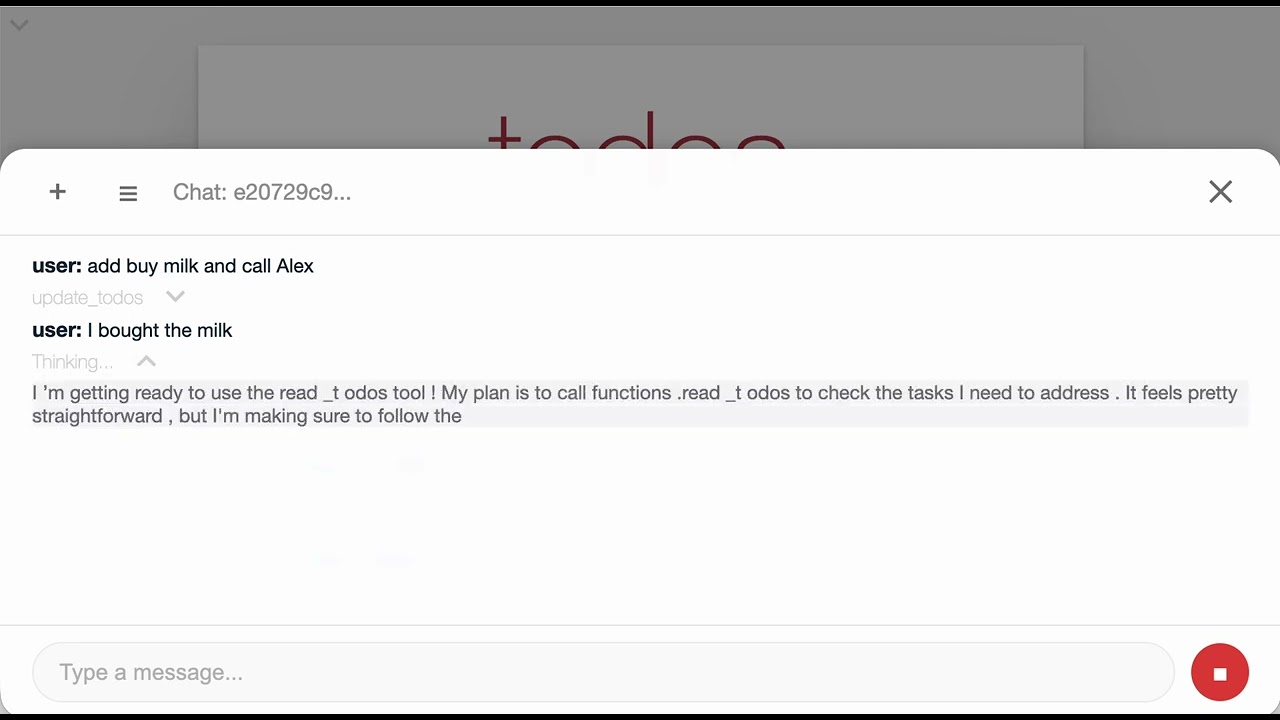
Wiring it into an application
The library ships no routes: your base owns them. Mount the three handlers on these three shapes
(reitit shown; any router that sets :path-params works):
(require '[taia.ds.datastar.interface :as ds])

["/ds"
 ["/nds"
  ["/:component/:component-id/:controller/:event" {:handler ds/handler-component-event}]
  ["/:component/:component-id/:event"             {:handler ds/handler-component-event}]]
 ["/nds-connect"
  ["/:component/:component-id/:event"             {:get  {:handler ds/handler-connected-component-connect}
                                                   :post {:handler ds/handler-connected-component-event}}]]]
The handlers expect, on the request:
| Key | Who sets it | Used for |
|---|---|---|
:path-params :component :component-id :event (:controller optional) | router | which component / FSM event |
:body-params (JSON, e.g. via muuntaja) or [:params :datastar] (GET) | your middleware | the signal store round-trip |
[:params :logged-user :user/id] | your auth middleware | keys SSE connections per user |
:app-config (optional) | your middleware | forwarded into the component ctx |
handler-connected-component-connect is async-only ([req respond raise]): run Jetty with
:async? true (or an equivalent async adapter).
At startup:
(ds/set-component-search-paths! ["my.app.components"])   ; required: the default is empty
(future (ds/warm-component-cache! ["home.home" "chat.chat"]))   ; optional, avoids first-request load cost
(ds/set-observer! my-metrics-fn)                                 ; optional, see docstring
Static assets — add (ring.middleware.resource/wrap-resource handler "datastar") (plus
wrap-content-type, browsers refuse a module script without a MIME type) and load them from your
page head:
[:script {:type "module" :src "/js/datastar.js"}]     ; Datastar v1.0.0-RC.8
[:script {:src "/js/sse-reconnect.js" :defer true}]   ; reconnect watchdog for /ds/nds-connect streams
Server-initiated pushes to an open connected component:
(ds/send-ui! component-id user-id [[:patch [:div#cc1 "hello"]]])
Full-page renders at a canonical URL (GET / → a page component's INIT):
(let [{:keys [html]} (ds/process-component-event req "home.home" "home" "INIT" nil)] ...)
Writing a component
Under one of the search-path prefixes, <dir>.<name> is resolved from "<dir>.<name>":
my/app/components/counter/counter.clj             ; (ns my.app.components.counter.counter)
my/app/components/counter/counter_controller.clj  ; (ns my.app.components.counter.counter-controller)
counter.cljdefines(defn counter [ctx] ...)— the render fn is named after the last namespace segment and returns hiccup. Useds/ctx->data-signalsfor thedata-signalsattribute.counter_controller.cljdefinesmachine, a hierarchical state machine map (:id,:initial,:states,:on); actions are(fn [ctx params] -> ctx).- Events arrive as
POST /ds/nds/counter.counter/<id>/<EVENT>;:memoryis your persistent state,:statethe FSM state keyword.
The examples go from a counter to TodoMVC.
Effect vocabulary a render fn may return instead of plain hiccup: [[:patch hiccup opts] …],
[:patch-signals map opts], [:execute-script js opts]; opts keys/values may be :d*/… keywords
(resolved against starfederation.datastar.clojure.api). send-ui! additionally accepts
[:broadcast hiccup opts] to reach every user connected under a component-id.
Development
This is a Polylith workspace.
bb test          # Kaocha + RCF inline tests (clojure -M:dev:test)
bb e2e-test      # Playwright against the examples app (needs Node >= 18); bb e2e-test <spec> [--headed]
bb check         # poly check
bb info          # poly info
bb dev           # examples app on port 7788, prints the examples URL (nREPL on 7789)
bb api-index     # regenerate docs/api.md from the interface namespaces
bb format        # cljfmt
bb jar           # target/taia.ds-<version>.jar  (version = 0.1.<git commit count>, or :version "x.y.z")
bb install       # into ~/.m2
bb deploy        # to Clojars
clojure -M:poly <cmd> runs any other poly command. The library artifact is projects/taia-ds
(the four bricks, nothing else); projects/examples adds the examples base and is never
published. build.clj inlines the bricks into one jar whose pom lists Maven libraries only.
Publishing
- Verify the
io.github.danbuneagroup once on Clojars: create a public GitHub repository namedclojars-danbunea(see Verified Group Names). - Create a Clojars deploy token and export
CLOJARS_USERNAMEandCLOJARS_PASSWORD(the token). bb deploy(optionallybb deploy :version '"0.3.0"'), then tagv<version>.
Migrating from the in-app namespaces
| Before (in-app) | After |
|---|---|
ds.interface, ds.adapters.*, ds.domain.* | taia.ds.datastar.interface, taia.ds.datastar.adapters.*, taia.ds.datastar.domain.* |
state-machines.* | taia.ds.state-machines.* |
logging.interface | taia.ds.logging.interface |
extensions.interface | taia.ds.extensions.interface |
search path "ds.adapters.components" | gone: the library has no components of its own, so the default is [] and the application lists only its own prefixes |
License
Eclipse Public License 2.0.
Can you improve this documentation?Edit on GitHub
cljdoc builds & hosts documentation for Clojure/Script libraries
| Ctrl+k | Jump to recent docs |
| ← | Move to previous article |
| → | Move to next article |
| Ctrl+/ | Jump to the search field |